
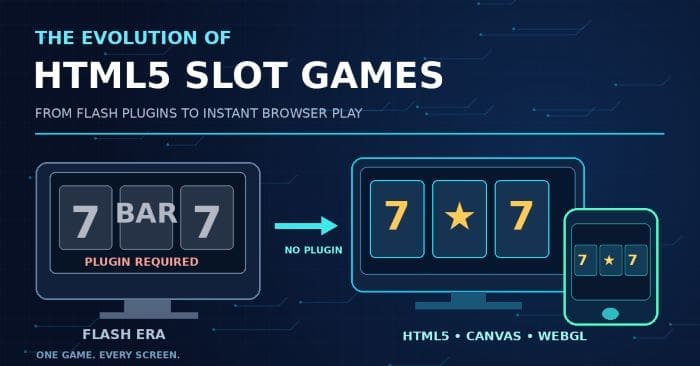
If you played online slots prior to 2012, then you likely remember the gray box. You’d load a casino lobby, select a game, and receive a rectangle stating you should download or upgrade Flash Player. Then you’d restart your browser and hope the plug-in hadn’t crashed during the course of a bonus round. That’s how it typically was. No One particularly enjoyed it, yet no One else had an alternative either. HTML5 slot machines corrected this. Most players never even realized that an improvement occurred. The greatest technologies are those that become invisible.
HTML5 slot machines—what are they?
The name is somewhat confusing. HTML5 is not one thing that you install. It is a group of open web standards developed and managed by the WHATWG with the w3c that Browsers naturally support. When individuals refer to “HTML5 slots,” they are referring to slot games developed with native tools supplied by the browser: JavaScript for logic appearing on the screen, the HTML5 Canvas element for 2-d graphic drawing, WebGL for hardware-accelerated graphics, CSS3 for designing layout and interfaces, and the Web Audio API for sounds. Since all of these components reside within Chrome, Safari, Firefox, and Edge, an HTML5 slot machine game will begin operating within the browser instantly.
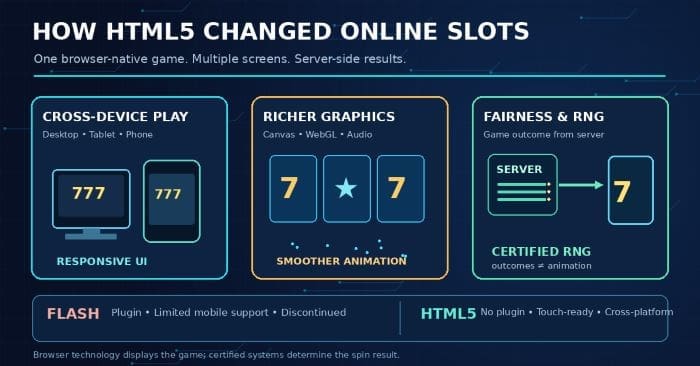
There is no plug-in, no installation, and no separate casino application. You simply click on the thumbnail for the game and the wheels begin spinning. This next point is significant when discussing fairness. What you see is merely the presentation layer. Within a properly constructed and regulated slot, the outcome of every spin is determined by a certified random number generator residing upon the provider’s server.
The flash era — why online slots needed change
Flash deserved recognition. Throughout the bulk of the 2000s, it was the sole realistic method for placing animated and interactive content in a browser. Casino studios created large catalogs of products utilizing Flash and ActionScript, whereas older platforms utilized Java applets or Shockwave together with Flash. If you desired more substantial capabilities, you downloaded a complete casino client onto your Windows pc, which consisted of approximately 300 mb of software primarily for executing slots and blackjack. Problems accumulated rapidly. Flash was a proprietary plugin; thus, any security vulnerability contained in it represented a vulnerability within your browser as well.
There were numerous vulnerabilities throughout its history. Additionally, it consumed laptop batteries due to excessive CPU usage. Flash had poor touch input capabilities due to its construction based upon mouse pointers. Lastly, Flash virtually ceased existing on mobile devices. The latter issue ultimately led to change. The iphone released in 2007 without flash and never received it. In 2010, Steve Jobs wrote his “Thoughts on Flash” letter explaining why Apple refused to support Flash. Adobe ceased developing Flash for mobile Browsers by late 2011.
Migrating from Flash to HTML5
The transition was not a singular event; rather, it transpired over the span of a couple of decades. The first phase involved mobile specifically. Approximately 2011, a handful of prominent studios commenced releasing “mobile” versions of their leading titles. These were distinct builds for mobile Browsers; often they featured simpler animation compared to their desktop counterparts. NetEnt’s touch series was among the initial examples of such attempts. At this juncture, a casino may have utilized two versions of the exact same slot: One Flash version for desktop users and one HTML5 version for mobile users, with two unique codebases to support and maintain, in addition to two different sets of bugs. The second phase evolved once studios recognized that supporting dual versions was wasteful. Due to enhanced browser capability, an HTML5 rendition of a game could be identical to its Flash counterpart in terms of appearance.
New games began being developed solely in HTML5 and served all devices from a single codebase. By roughly the mid-2010s, creating new slots in Flash no longer possessed viable financial merit. The final phase represented the clean-up process. Providers were required to determine whether to rebuild hundreds of legacy casino games in html5; if applicable, perhaps providing updated visuals and renaming them. An overwhelming quantity of lesser-known games simply vanished forever. If you’ve previously attempted to locate an outdated favorite and discovered absolutely nothing, that is likely exactly what happened to it. Rebuilding a Flash game wasn’t as straightforward as exporting.
Cross-device compatibility on desktop/ mobile/tablet
The largest tangible difference is that today one game functions on any device type. The exact same HTML5 online slot operates on a Windows laptop with Chrome, an iPad with Safari, and on any mid-range Android smartphone. That represents true cross-platform casino gaming generated from a single codebase; that dramatically altered how studios design games. Although mobile initially trailed desktop during the Flash era, today it leads. Numerous operators report that greater than half of their slot sessions occur on mobile phones; as such, game design has shifted accordingly. Symbols are larger and clearer; spin buttons situate where thumbs land; and pay tables appear as scrollable panels rather than minuscule pop-up windows. Many contemporary games are originally developed for portrait orientation first, although this would have appeared absurd in 2010 when each slot was a wide rectangle intended for monitors.
Although cross-browser compatibility is improved over older times — still issues remain
There is no doubt that responsive design can easily be underestimated. An earlier slot built with Flash had a predetermined size; it was designed to function with one specific resolution; therefore, it either enlarged poorly or shrunk poorly depending on the display quality of the monitor it resided upon. Modern slots utilize responsive design principles (media queries / flexible viewport / scaling canvases), therefore the interface adjusts according to the size of the screen it resides upon. Rotate your phone from portrait to landscape mode in a well-designed modern slot; the reels adjust position; the bet controls relocate to the right-hand side; and the display showing your account balance relocates to a location elsewhere on the screen. That is adaptive game design; however, adaptive design requires considerable effort since each layout must undergo rigorous testing on actual devices.
What HTML5 enables contemporary slot features
That is where this becomes fascinating for gamers. Once studios possessed a functional and malleable platform capable of functioning on each device, game mechanics significantly increased in ambition. Megaways is perhaps the most recognizable illustration. Big Time Gaming’s mechanism, introduced in 2016, modifies the quantity of symbols on each reel after every spin, producing up to 117,649 potential combinations on the original edition of Megaways. Graphically, this translates into continually changing sizes and orientations of reels, which fits perfectly with modern rendering capabilities. Other innovative mechanisms such as cluster pays, cascading reels, hold & win respin features, growing grid structures and multi-staged bonus rounds are all dependent upon smooth animations being executed successfully on smartphones.
Furthermore, interactive features within bonus sections expanded as well. Pick-and-click style bonuses transformed into small mini-games. Some modern slots currently include additional layers of progression, including collecting symbols that remain active between plays, and gamification layers, including missions and achievements. Live progressive jackpots within slots possess real-time jackpot displays that are continuously updating without requiring reloads via WebSockets.
Future of HTML5 online slots
HTML5 has succeeded; therefore, the intriguing question is what will eventually be layered atop HTML5. WebGPU is clearly the most logical place for further advancement. It is essentially the next-generation replacement for WebGL, enabling developers with low-level access to GPU functionality while providing higher levels of efficiency; presently, WebGPU supports development across all major Browsers. Presumably for slot manufacturers, WebGPU enables for potentially richer 3D scenes along with more complex visual effects while simultaneously reducing power consumption on portable devices; however, i believe developers will take their time to adopt WebGPU as developers cannot abandon devices lacking WebGPU capabilities.
WebAssembly is another item worth monitoring; it enables high-performance code execution in Browsers at near native speeds, assisting in physics simulations, complicated animations, and porting engines from other platforms. Situated somewhere in-between progressive web applications represent an interesting intermediate area of focus. Progressive web apps enable casinos to provide experiences that resemble installed applications, with icons placed on users’ home screens, allowing for full-screen operation along with quicker repeat loads; however, they avoid undergoing approval processes located within app stores due to variable regulations regarding real-money gaming across countries.
HTML5 slot games FAQs
What are HTML5 slot machine games?
HTML5 slot machine games are slot games created utilizing browser-native web technologies including JavaScript, canvas, WebGL, and CSS3 that execute directly in your browser on any device without plugins or downloads.
How did HTML5 alter online slot gaming?
It eliminated the necessity for Flash; allowed one game to operate across all desktop/tablet/smartphone types; and enabled developers to create graphics/animation/sounds utilizing hardware acceleration/touch inputs. These factors opened doors for the present-day mobile-centric/high-feature online slots we experience today.
Why did casinos replace Flash with HTML5?
Casinos abandoned Flash due to ongoing security issues surrounding Flash; it lacked support on iPhones; and Adobe officially ceased developing Flash for mobile Browsers by late 2011. As mobile usage increased, players/casinos needed games that could be accessed on multiple devices; thus, HTML5 filled that void.
Will HTML5 slot games function on my iPhone and/or Android device?
Yes — they operate within Safari and Chrome as well as various other mobile browser applications on both platforms. Devices dating back several years may struggle with extremely visually intense titles; however, most recent year-plus smartphone devices will function appropriately with such titles.
Must I download any programs to operate HTML5 slot games?
No — you launch the game within your browser and it begins operating immediately. Some casinos also offer downloadable applications/web-applications; however, neither is required to operate HTML5 slot games.
Are HTML5 slot games better than their Flash counterparts?
In almost every practical aspect — yes. They are safer; operate across more devices; operate more efficiently/smoothly; and support far superior graphics/animations/features than their predecessors.
What technologies do HTML5 slot games utilize?
Typical utilization includes JavaScript/CSS3/canvas/WebGL/web audio API/WebSockets — when applicable (e.g., displaying live jackpot values). Determination of slot game results occurs remotely from certified random number generators.