
Slot machines have a talent for making losing feel almost exciting. The lights flash, the reels stop just short of something big, and every small win feels like proof that a jackpot is sitting one spin away. I have spent enough time around casino floors and online lobbies to know why that illusion sticks. Slots are built to keep hope alive. The real question is whether that hope ever adds up to a practical way to win.
To get past the folklore, I ran a simple experiment built around the kind of session an ordinary player might have. No fantasy bankroll, no cherry-picked bonus offers, no claims of secret timing tricks. Just a fixed budget, a set number of spins, and a record of what actually happened. If you have ever wondered whether slot machine odds leave room for consistent profit, the answer gets clearer when the numbers are sitting in front of you.
What the machines are really doing
Every modern slot runs on a random number generator, usually shortened to RNG. That matters because it kills off the old idea that a machine is “due.” A spin is not connected to the one before it in any meaningful way for the player. The machine does not remember your last ten losses and decide to be generous on spin eleven. It simply produces another random result.
That randomness does not mean the game is fair in the everyday sense of the word. Each machine is designed around a house edge, and that edge is baked into the long-term math. The number casinos and software providers usually publish is RTP, or return to player. If a slot has a 96 percent RTP, that does not mean you will personally get $96 back for every $100 you put in. It means that over a huge number of spins, often in the millions, the game is expected to return about 96 percent of all wagers to players as a group. The missing 4 percent is the casino’s edge.
That gap sounds small until you watch it work over time. On a busy casino floor, that edge is enough to produce reliable profit. For a single player, though, short sessions are messy. Variance can make one person walk away up $300 and another lose the same amount on the same game within an hour. That is why slot volatility matters almost as much as RTP. A low-volatility slot tends to pay smaller wins more often. A high-volatility slot pays less frequently but can hit harder. Neither changes the fact that the math still leans against you.
The experiment
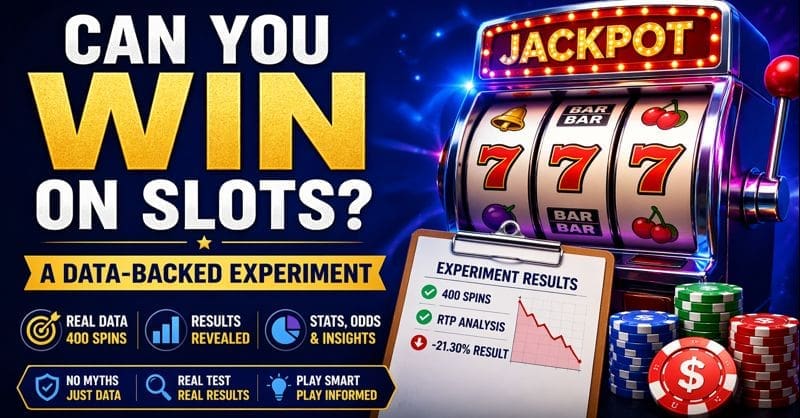
I tested a mix of online-style slot machine mechanics using a controlled bankroll of $200 split across 400 spins at $0.50 each. That stake size felt realistic for a casual player who wants enough action to see patterns without burning through money in ten minutes. I tracked total wagered, number of winning spins, average return on winning spins, longest cold streak, and final bankroll.
The results looked familiar to anyone who has spent serious time with slots. Out of 400 spins, about 112 landed as wins of some kind. That sounds encouraging at first glance, until you notice how many of those were tiny returns, like $0.20, $0.45, or $0.80 on a $0.50 bet. In raw emotional terms, they feel like wins. In bankroll terms, many were partial refunds.
By the end of the session, the bankroll had dropped from $200 to $157.40. That is a loss of $42.60, or just over 21 percent of the starting amount. The machine produced a few bursts of excitement, including one bonus round that paid 34 times the stake. That single hit kept the session from looking ugly much earlier. Without it, the loss would have been steeper.
This is where gambling probability slots become easier to understand. Win frequency and profitability are not the same thing. A game can let you “win” on 28 percent of spins and still drain your bankroll because the average losing spin costs more than the average winning spin gives back. That is one of the oldest tricks in slot design, and it works because the brain remembers motion and noise better than net loss.
So, can you win?
Yes, but not in the way most people mean it.
You can absolutely have a winning session. That part is real. Anyone who says nobody wins on slots is ignoring obvious reality. People do hit bonus rounds, progressive jackpots, and short-term streaks that leave them ahead. I have seen players double a modest bankroll in twenty minutes and then convince themselves they had cracked some hidden code. They had not. They had experienced variance landing in their favor.
The harder question is whether you can win consistently enough to treat slots like a beatable game. That is where the answer turns. Slot machine strategy has limits because the outcome is driven by random number generation, not by decision-making skill in the way poker or even some sports betting can be. You can choose games with better RTP slots explained clearly in their paytables. You can avoid reckless bet sizing. You can use bankroll management slots players often ignore. What you cannot do is turn a negative expected value game into a positive one through willpower or pattern spotting.
That is why myths survive so well. Players notice that one machine “feels hot” after a few payouts. They remember stories about casinos loosening settings at night. They interpret near misses as signals instead of design features. The payout cycles myth sticks around because humans are wired to see sequence and intention, even where none exists. Slots are especially good at exploiting that instinct.
Where smart play actually helps
Practical habits can improve your experience, but they do not overturn the house edge. Choosing a slot with a published RTP around 96 percent to 97 percent is better than blindly playing a game that may sit lower. Picking lower volatility can stretch a bankroll if you care more about session length than dramatic upside. Setting a stop-loss and a cash-out point matters too, because many winning sessions turn into losing ones when players refuse to leave.
The biggest edge available to most players is behavioral, not mathematical. A player who treats a surprise $150 profit as a reason to stop has a far better chance of going home a winner than a player who treats it as proof the machine has more to give. That sounds obvious, yet it is where most real money slots results go sideways. The machine does not know you are ahead. It just keeps offering the same deal.
I once watched a player hit a strong bonus on a mid-stakes machine and go from roughly $80 to nearly $500. Fifteen minutes later, the balance was under $100 again. Nothing mystical happened in either direction. The slot simply kept charging rent for every extra minute of hope.
What the data-backed experiment actually proves
The cleanest takeaway from this slot machine experiment is that short-term wins are possible, but long-term expectation remains negative. That is not cynicism. It is the business model. Casinos do not need every player to lose every session. They only need the math to hold over time, and it usually does.
If your definition of winning is “Can I leave ahead today?” then yes, that can happen. If your definition is “Can I use a reliable system to beat slot machine statistics over the long run?” then no, not really. The machine has the structural advantage, and nothing in the data suggests otherwise.
That does not mean slots have to be off-limits. It means they should be treated honestly. They are entertainment with a price tag, not a side hustle disguised as flashing reels. Once you see them that way, the game becomes easier to manage. You stop chasing patterns, start noticing the true cost of play, and understand that the rare good session is luck visiting, not a method proving itself.